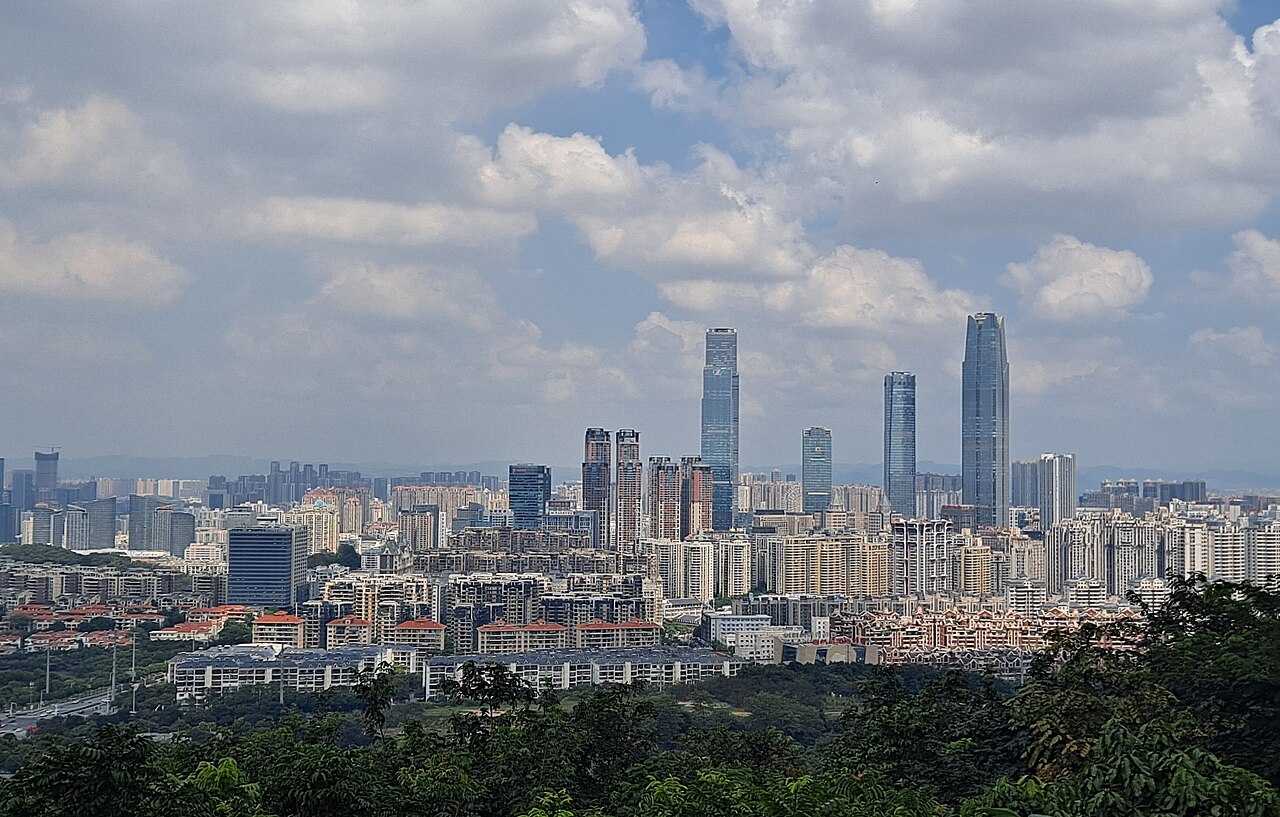
Silver Beach
About 24 km of fine quartz sand on the city's south-east shore, with the giant steel sculpture 'Chao' (Tide) and its musical fountain at its centre. Free, and at its best in the late afternoon.
Beihai · Guangxi
Beihai is Guangxi's Gulf of Tonkin coast: 24 km of Silver Beach, the volcanic island of Weizhou with its coral, and an 1883 old street. Private Beihai tours from US$139 a day.
The short version
The place itself
Beihai sits on the north-east shore of the Gulf of Tonkin, close to Vietnam, and it has one claim that has carried it for years: the beach. Silver Beach runs some 24 km of unusually fine, white, quartz sand, flat and shallow and gentle, which locals sell with a five-character slogan — long, flat, fine, soft, no sharks. It is the best city beach in Guangxi and one of the best in southern China.
The real draw, though, is 36 nautical miles offshore: Weizhou Island, the youngest and largest volcanic island in China. It is a place of black lava rock, coral shallows, blown sea cliffs and a 19th-century French church built from coral and stone. Visibility in the water reaches 8 m and often more, and the diving and snorkelling are the best on this coast. Come for two days and stay the night, or you will spend it all on the ferry.
Back on the mainland, the old street — Zhuhai and Zhongshan Roads, built in 1883 — is a 1.44 km run of Qilou arcade buildings mixing Chinese and European detail, and the surrounding coast is dotted with pearls, mangroves and the tombs of the ancient Hepu commandery. This was one of the starting ports of the maritime Silk Road two thousand years ago.
Beihai is easy, cheap and unhurried, and it works either as a beach break on the way between Nanning and the sea, or as a base for the crossing to Hainan. Just leave the logistics of Weizhou to the weather — the boats stop when it blows.
Pins are plotted from real latitude and longitude on a 5° graticule. This is a schematic orientation diagram, not a political map — no boundaries are drawn.
About 24 km of fine quartz sand on the city's south-east shore, with the giant steel sculpture 'Chao' (Tide) and its musical fountain at its centre. Free, and at its best in the late afternoon.
China's youngest volcanic island, 36 nautical miles offshore, with a crater park, coral beaches, a coral-built French church, and the best diving on the Guangxi coast. The ferry takes 1–1.5 hours and the landing fee is separate.
Zhuhai and Zhongshan Roads, laid out in 1883 and running 1.44 km, lined with arcade buildings that blend Cantonese shophouse form with European baroque detail. Still a working street, best walked in the cool of the morning or evening.
The island's headline sight is the volcanic crater on its south-west side, with lava formations, sea caves and layered sea-cliffs. The western beaches of Shiluokou are where the coral and the clearest water are.
The forested headland at the city's western tip, with the 120 m (394 ft) Wanglou peak, sea-eroded platforms and the best spot for sunrise, sunset and the twinkle of fishing lights at night.
The old commandery town of Hepu, an hour away, holds the Wenchang Pagoda, Su Dongpo's pavilion and a Han-dynasty tomb field of some 10,000 graves — evidence of the port that traded west 2,000 years ago.
Beihai Fucheng Airport (BHY) has a small schedule — mostly flights from major cities, and it is prone to cutbacks. The practical route for most travellers is to fly into Nanning Wuxu (NNG) or Guilin and continue by high-speed rail, which reaches Beihai from Nanning in about three hours.
By rail, Beihai connects to Nanning on the fast line; by road, Nanning is about 206 km (3h) and Zhanjiang about 160 km (1.5h). There is also a sea route to Haikou on Hainan, an overnight ferry that takes about 12 hours.
Inside the city, bus 3 is the workhorse, linking the Northern Gulf Plaza, the coach station, the international ferry pier, the beach park and Silver Beach. Taxis start at ¥5, an intra-city trip rarely tops ¥10, and from the centre to Silver Beach or the ferry pier is about ¥15–20.
| Month | Weather | Crowds | Verdict |
|---|---|---|---|
| January | 12°C / 4°C · cool, damp | Quiet | Good |
| February | 14°C / 6°C · cool, damp | Very busy | Good |
| March | 18°C / 10°C · clear and mild | Moderate | Best |
| April | 24°C / 16°C · clear and mild | Moderate | Best |
| May | 28°C / 21°C · cool, damp | Busy | OK |
| June | 32°C / 25°C · very hot, humid | Moderate | OK |
| July | 35°C / 28°C · cool, damp | Busy | Avoid |
| August | 34°C / 27°C · cool, damp | Busy | Avoid |
| September | 29°C / 23°C · very hot, humid | Moderate | OK |
| October | 24°C / 17°C · clear and mild | Very busy | Best |
| November | 18°C / 11°C · clear and mild | Quiet | Best |
| December | 13°C / 6°C · cool, damp | Quiet | Good |
Three days: one for Silver Beach, the old street and Guantouling, and two for Weizhou Island, staying overnight so you get the sunrise and the empty beaches after the day-trippers leave. If you cannot spare the two nights, at least do Weizhou as an overnight rather than a day trip — the ferry alone eats half a day each way. Add a day for Hepu's tombs and pagoda if you like old towns.
Plan these days properly Transport
China's High-Speed Rail: How to Book, What It Costs, How Fast It Goes
The fastest way to cross China is also the most pleasant. Here is how to book a ticket with a foreign passport, what the three classes actually give you, and how to survive a Chinese station at rush hour.
9 min read
Transport
China's High-Speed Rail: How to Book, What It Costs, How Fast It Goes
The fastest way to cross China is also the most pleasant. Here is how to book a ticket with a foreign passport, what the three classes actually give you, and how to survive a Chinese station at rush hour.
9 min read
 Planning
Best Time to Visit China: Month by Month, Region by Region
China is the size of Europe, so 'the best month' depends on where you stand. Here is the month-by-month answer for the north, the Yangtze valley, the south and the plateau.
8 min read
Planning
Best Time to Visit China: Month by Month, Region by Region
China is the size of Europe, so 'the best month' depends on where you stand. Here is the month-by-month answer for the north, the Yangtze valley, the south and the plateau.
8 min read
 Food
Chinese Food Culture: Eight Cuisines, One Table
There is no such thing as Chinese food. There is Cantonese, Sichuan, Hunan, Jiangsu, Zhejiang, Fujian, Anhui and Shandong — and knowing which one you are eating changes everything.
8 min read
Food
Chinese Food Culture: Eight Cuisines, One Table
There is no such thing as Chinese food. There is Cantonese, Sichuan, Hunan, Jiangsu, Zhejiang, Fujian, Anhui and Shandong — and knowing which one you are eating changes everything.
8 min read
Take the ferry from Beihai's international passenger pier. The crossing is about 1–1.5 hours and boats generally leave around 8:30, 11:30 and 15:45, with more services in peak season. The ferry ticket and the island landing fee are separate, and both are weather-dependent — if the wind is up, sailings are cancelled, so build in a spare day.
Yes, and it is almost worth two. A day trip leaves you about three hours on the island after the crossing. Staying the night gives you the sunrise over the sea, the quiet beaches once the day boats have gone, and time for the crater park, the coral beaches and the church without rushing.
April to November, when the sea is warm and the ferries run reliably; April, May and October are the sweet spot — mild, sunny and quieter. December to March is the low season, with cold wind, cool water and frequent ferry cancellations to Weizhou. Winter is only worth it if you simply want to escape the northern cold.
Most travellers fly into Nanning (NNG) or Guilin and continue by high-speed rail — Nanning to Beihai is about three hours. Beihai also has a small airport (BHY) with a limited schedule. By road it is about 1.5 hours from Zhanjiang and three hours from Nanning.
Seafood, and the local specialities: mantis shrimp, white-blanched sandworm (a Gulf of Tonkin delicacy), prawns, and the street snack xia bing, a fried prawn pancake. Congee and pig-trotter noodles are the everyday staples, and the sweet soups in the Waisha district are an institution.
Yes — Beihai is one of China's closest ports to Vietnam, and there are regular tours to Halong Bay and Hanoi. The Halong Bay route is the one stretch of Vietnam that Chinese citizens can enter without a visa, but only with an organised tour. Otherwise you cross by land at Dongxing, which needs a passport and a visa.
Free itinerary design, a revised plan within one working day, and nothing charged until you approve the final version.