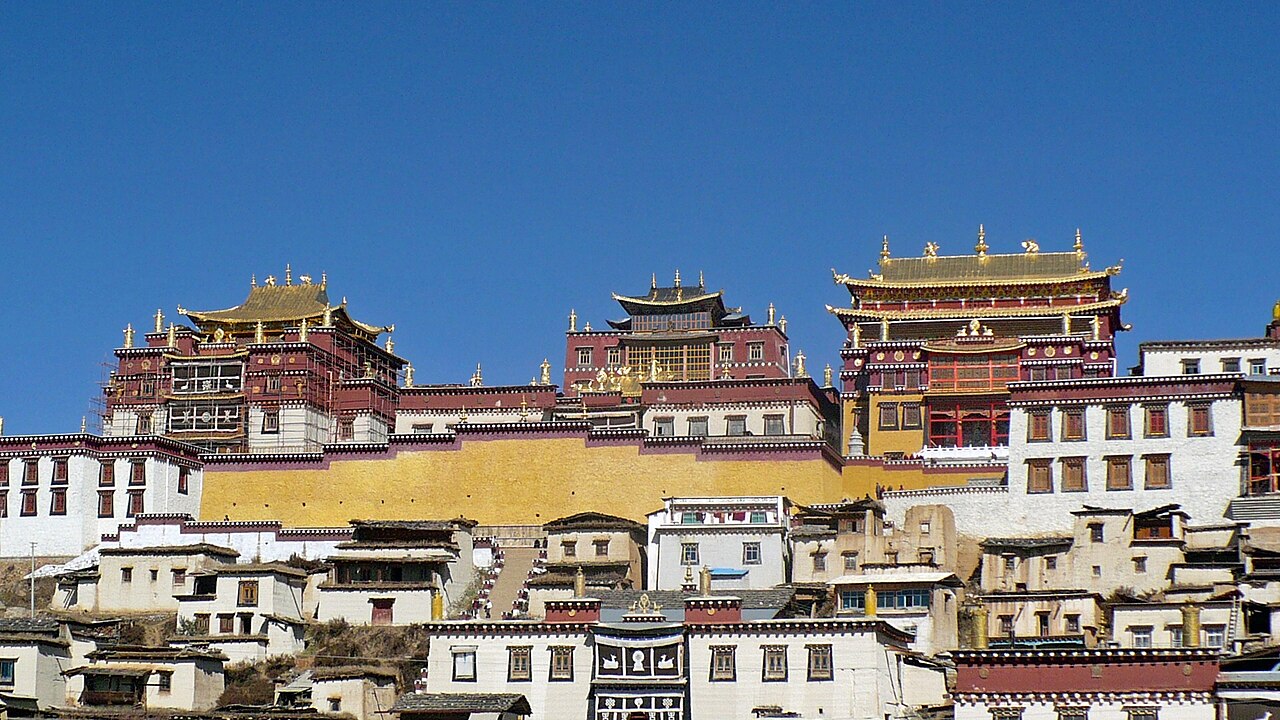
Daocheng Yading sits in the far south-west of Sichuan, in the Garzê Tibetan Autonomous Prefecture on the south-eastern edge of the Qinghai-Tibet Plateau, and it is the landscape the phrase 'the last Shangri-La' was coined for. Three snow peaks stand in a rough triangle inside the reserve: Xiannairi, the north peak, at 6,032 m; and to the south and east, Yangmaiyong and Xianuoduoji, both at 5,958 m. Tibetan tradition names them the three bodhisattvas — Avalokitesvara, Manjushri and Vajrapani.
The reserve is arranged like a staircase up a valley, and most people walk it over two days. The short line climbs gently from the Chonggu Temple lawn to Pearl Lake, a green, still pool directly below Xiannairi — half a day at most, and the easiest real taste of the scenery. The long line is the famous one: an electric cart to the Luorong pasture, then a hard 5–6 hour walk (or a 4-hour horse ride) up to Milk Lake, a small glacial tarn under Yangmaiyong, and on to Five-Colour Lake at 4,600 m, where the water shifts through five colours in the light.
The altitude is the other half of the trip, and it is not a detail. The reserve floor is around 4,000 m and the big lakes sit higher still, so the sensible approach is to arrive at Daocheng town (3,740 m), sleep there, and only then drive the 3 hours in to Yading village. The town's own surroundings — the poplars and fields along the Bang River, the red grassland at Sangdui in early October, the monasteries on the way in — are worth a slow day of their own.
This is not a comfortable destination and it does not pretend to be. Food inside the reserve barely exists, beds in Yading village are simple, and the weather changes by the hour. What you get for the effort is one of the last genuinely wild high places in China, and the three peaks standing over it.