Libo · Guizhou

Libo Tours & Private Guizhou Trips 2026 | Xiaoqikong Seven-Arch Bridge, Maolan Karst Forest, Dachikong | JoyoTour

Libo, Guizhou is the 'emerald on the earth's belt' — 2–3 days cover the Seven-Arch Bridge water colours, the 68-tier falls and the Maolan karst forest. Budget ¥600–1,500.

The short version

Libo is a small county in southern Guizhou, and its karst water scenery — the Seven-Arch Bridge (Xiaoqikong) scenic area and the Maolan primeval forest — is among the best in China. Two to three days is enough to see both, and you should budget ¥600–1,500 per person excluding flights. Xiaoqikong entry is ¥110 in summer and ¥90 in winter, plus a mandatory ¥40 shuttle; Maolan reserve tickets are ¥50. The two scenic areas sit 3 km (1.9 mi) apart, and Libo has no railway station, so you arrive by road via Guiyang, Dushan or Mawei.

GuizhouProvince
April–May for rapeseed, July–August for wading and rafting, October–December for the clearest water colourBest months
KWEAirport
Connect via hubDaily intl. flights
Prefer it arranged for you? Emerald rivers threading through karst peaks, a 600-metre forest growing out of a riverbed, and China's largest wild plum grove. Libo travel guide →

The place itself

What Libo is actually like

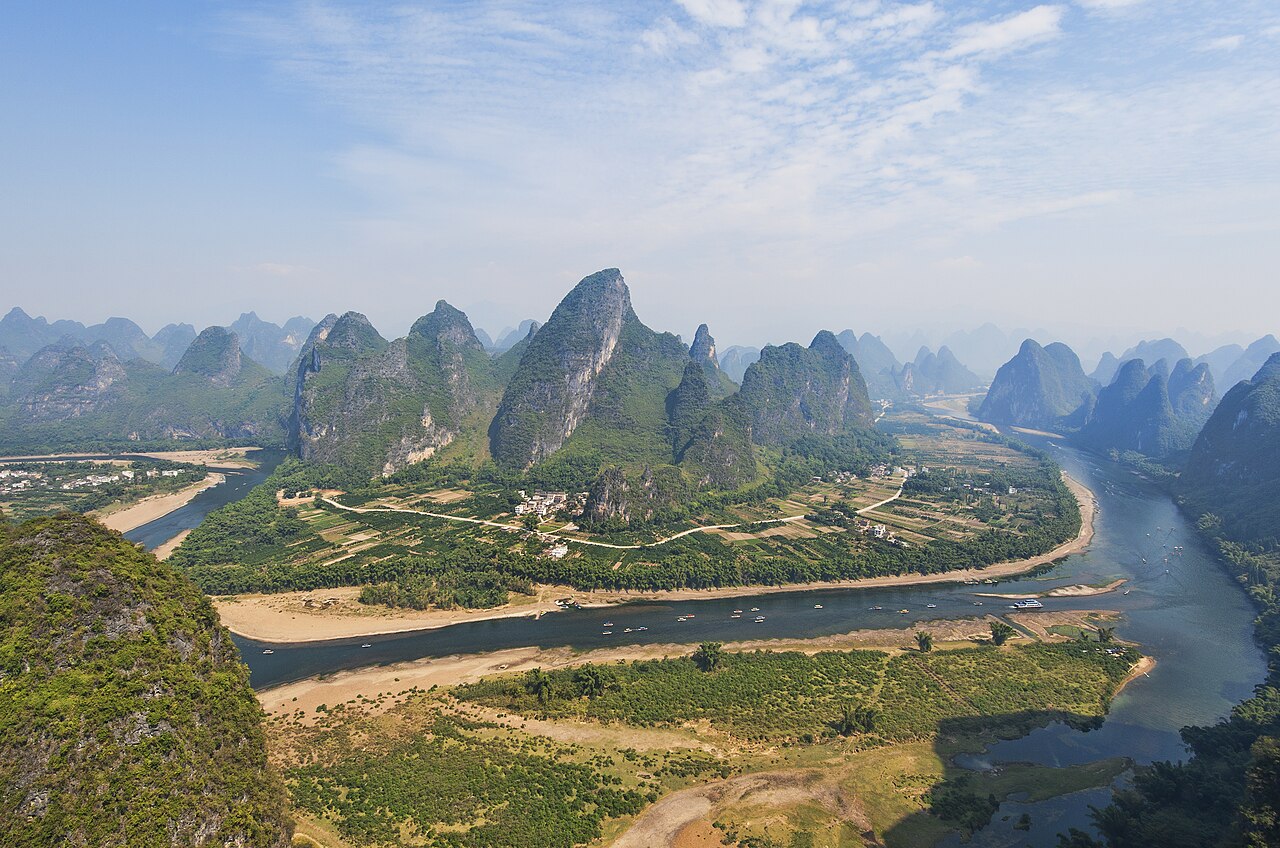
Libo is the reason people who think Guizhou is just mountains change their mind. The county sits in a deep river valley in the far south of the province, pressed against the Guangxi border, and everything worth seeing here is made of water and limestone: turquoise pools that hold their colour for reasons geologists still argue about, a river that pours over 68 separate ledges in 1.6 km, and a forest that grows straight out of bare rock.

The Xiaoqikong (Seven-Arch Bridge) scenic area is the famous half — the 1836 stone bridge itself, the 68-tier falls, the Laya waterfall that sprays onto the path, the water forest you wade through, and Wolong Pool with its unnerving blue. Twenty minutes down the road, Dachikong is the quieter, rougher sibling: a gorge, a 90 m natural stone bridge called the 'Eastern Triumphal Arch', and boat rides through it.

Then there is Maolan, and this is where Libo stops being a scenic spot and becomes a landscape. Two hundred square kilometres of primeval karst forest, one of the largest subtropical primary forests in China, dotted with Buyi villages, an old paper mill still working from bamboo, and a 1944 wartime cave where local militia held off the Japanese. It is best done by private car or chartered van, slowly, over a full day.
75°E75°E90°E90°E105°E105°E120°E120°E135°E135°E20°N20°N30°N30°N40°N40°N50°N50°N ChangchunKashgar BeijingBeijingXi'anXi'anShanghaiShanghaiChengduChengduGuilinGuilinHangzhouHangzhouZhangjiajieZhangjiajieTibet · LhasaTibet · LhasaYunnan · KunmingYunnan · KunmingSichuan · ChengduSichuan · ChengduQinghai · XiningQinghai · XiningGansu · LanzhouGansu · LanzhouXinjiang · UrumqiXinjiang · UrumqiInner Mongolia · HohhotInner Mongolia · HohhotGuangzhouGuangzhouShenzhenShenzhenHarbinHarbinDalianDalianShenyangShenyangChangbai MountainChangbai MountainKunmingKunmingDaliDaliShuheShuheLijiangLijiangXiamenXiamenGulangyuGulangyuFuzhouFuzhouLugu LakeLugu LakeXishuangbanna · JinghongXishuangbanna · JinghongShangri-LaShangri-LaNanchangNanchangHefeiHefeiHongcunHongcunWuhanWuhanChangshaChangshaFenghuang Ancient TownFenghuang Ancient TownLushanLushanWuyuanWuyuanMount Heng (Hengshan, Hunan)Mount Heng (Hengshan, Hunan)HuangshanHuangshanWudang MountainWudang MountainLuoyangLuoyangYuntai MountainYuntai MountainRizhaoRizhaoYantaiYantaiLianyungangLianyungangSanqing MountainSanqing MountainTianjinTianjinDatongDatongTaiyuanTaiyuanPingyaoPingyaoWutai MountainWutai MountainHulunbuir · HailarHulunbuir · HailarThe Forbidden CityThe Forbidden CitySanyaSanyaHaikouHaikouBeihaiBeihaiNanningNanningGuangxi · NanningGuangxi · NanningHuizhouHuizhouZhuhaiZhuhaiWuyi MountainWuyi MountainBeidaiheBeidaiheShanhaiguanShanhaiguanBaiyangdianBaiyangdianQinhuangdaoQinhuangdaoYesanpoYesanpoJiuzhaigouJiuzhaigouMount SiguniangMount SiguniangHailuogouHailuogouDaocheng YadingDaocheng YadingShunan Bamboo SeaShunan Bamboo SeaDujiangyanDujiangyanQingcheng MountainQingcheng MountainQingdaoQingdaoMount TaiMount TaiJinanJinanWeihaiWeihaiQufuQufuPenglaiPenglaiChangdaoChangdaoNanjingNanjingSuzhouSuzhouZhouzhuangZhouzhuangTongliTongliWuxiWuxiYangzhouYangzhouZhenjiangZhenjiangChangzhouChangzhouWuzhenWuzhenXitangXitangXixi WetlandXixi WetlandNingboNingboMount PutuoMount PutuoQiandao LakeQiandao LakeShaoxingShaoxingZhoushanZhoushanHengdianHengdianYandang MountainYandang MountainZhejiang · HangzhouZhejiang · HangzhouHong KongHong KongHong Kong Outlying IslandsHong Kong Outlying IslandsHong Kong ShoppingHong Kong ShoppingMacaoMacaoTaipeiTaipeiKaohsiungKaohsiungTaiwan · TaipeiTaiwan · TaipeiUrumqiUrumqiNorth Xinjiang · UrumqiNorth Xinjiang · UrumqiQinghai LakeQinghai LakeMount EmeiMount EmeiLanzhouLanzhouMount HuaMount HuaDunhuangDunhuangGannan · LanzhouGannan · LanzhouSichuan–Tibet Highway (G318) · Chengdu (CTU)Sichuan–Tibet Highway (G318) · Chengdu (CTU)KangdingKangdingLhasaLhasaNyingchiNyingchiNamtsoNamtsoChongqingChongqingQiandongnan · GuiyangQiandongnan · GuiyangLiboLiboGuiyangGuiyangZhenyuanZhenyuanHuangguoshuHuangguoshu
Destination — click to open the guide Province or autonomous region Provincial capital Major river

Pins are plotted from real latitude and longitude on a 5° graticule. This is a schematic orientation diagram, not a political map — no boundaries are drawn.

What not to miss — Libo

01

Wolong Pool

A small, unnaturally still pool inside Xiaoqikong where the water shifts from pale blue to deep cobalt depending on the light — it photographs like a painting and no filter really captures it. Best in autumn and winter when rainfall is low; summer flooding turns it brown.

02

The Water Forest

A 600 m stretch where trees grow rooted in the riverbed and the river runs clean over polished stone between them. You take off your shoes and walk the wet route downstream — genuinely fun, occasionally slippery, and the single most popular thing to do in the park.

03

68-Tier Falls

In a narrow 1.6 km valley above Hanbi Pool, the river drops over sixty-eight successive ledges, each a slightly different shape. So many falls packed into so short a stretch is rare anywhere in China; the wet route runs right alongside them.

04

Dachikong's Natural Bridge

A 90 m high, 50 m wide, 20 m thick limestone arch spanning the river, known as the 'Eastern Triumphal Arch'. From underneath, the stalactites all lean the same way — as if the cave were doing callisthenics. The gorge walk to reach it is called Terror Gorge, and it earns the name.

05

Maolan Karst Forest

China's largest subtropical primeval forest on karst, 20,000 hectares of trees that crack solid rock with their roots. Two of Libo's 'three wonders' are here — the Stone Forest, where trees split boulders, and the Water Forest, where they grow in the current.

06

Yaogu Buyi Village

A working Buyi village where elders still spin thread and brew rice wine, and a century-old paper mill still makes paper from mountain bamboo using the original method. It is inside the Maolan ticket, not a staged attraction.

Getting there and away

Libo has no railway station, which is the single most important thing to know before you plan. The standard route is a direct bus from Guiyang East bus station — six departures a day at 09:20, 11:00, 12:30, 14:00, 15:40 and 17:30, roughly four hours, ¥100. Coming from Guangxi, buses from Nanning (daily, 11:00) and Liuzhou (twice daily) run in. If you arrive by train, get off at Dushan (closer to the county town, buses every 30 minutes) or Mawei (closer to Xiaoqikong — ask the driver to drop you at the scenic area gate). Libo Airport, 12 km out of town, has limited seasonal services from Guangzhou and Chongqing; a shuttle bus takes 30 minutes to the county town.

Inside Libo, the county bus station runs a shuttle to Xiaoqikong every 15 minutes from 06:00 to 17:00 for ¥9. Taxis in town start at ¥4 and the town itself is small enough to walk. For Maolan you really want a car: a chartered 7-seat van with driver starts around ¥300 a day, and Xiaoqikong return transfers from ¥150. Fill your tank before you leave — there are only two petrol stations in Libo town and none at all inside the Maolan reserve, and after 6pm you need a fuel card.

Best time to visit — Libo

MonthWeatherCrowdsVerdict
January12°C / 4°C · cool, dampQuietGood
February14°C / 6°C · cool, dampVery busyGood
March18°C / 10°C · clear and mildModerateBest
April24°C / 16°C · clear and mildModerateBest
May28°C / 21°C · cool, dampBusyOK
June32°C / 25°C · very hot, humidModerateOK
July35°C / 28°C · cool, dampBusyAvoid
August34°C / 27°C · cool, dampBusyAvoid
September29°C / 23°C · very hot, humidModerateOK
October24°C / 17°C · clear and mildVery busyBest
November18°C / 11°C · clear and mildQuietBest
December13°C / 6°C · cool, dampQuietGood

How many days do you need?

Two days is the honest minimum: day one for Xiaoqikong (allow six hours inside, plus the drive), day two for a Maolan loop by car. Three days lets you add the Shuichun River rafting and Dachikong on a relaxed first day. Anything under two days and you are paying a lot of travel for a very short look.

Plan these days properly

Frequently asked questions

When is the best time to visit Libo?

It depends which Libo you want. July and August are best for wading the water forest and rafting the Shuichun River, when water volumes are high. October to December gives the clearest, most saturated colours at Wolong Pool — summer flooding muddies it. April and May are for rapeseed and plum blossom around Maolan. Every season has a reason.

How do I get to Libo without a car?

Bus from Guiyang East station, six a day, about four hours, ¥100. Alternatively take a train to Dushan or Mawei and transfer by bus — Dushan is closer to the county town, Mawei to Xiaoqikong. Once there, the county bus station runs shuttles to Xiaoqikong every 15 minutes for ¥9.

Is Libo worth visiting if I only have one day?

Yes, but only do Xiaoqikong. The classic one-day route is Bronze Drum Bridge, Seven-Arch Bridge, the 68-tier falls, Laya waterfall, the water forest, Wolong Pool and Yuanyang Lake — six hours inside the park. Buy the ¥40 shuttle bus ticket; walking between sights is not realistic.

How much does Libo cost per day?

Budget ¥600–1,500 for a two-to-three-day trip excluding flights. Tickets add up: Xiaoqikong ¥110 in summer plus ¥40 shuttle, Dachikong ¥55 plus ¥20 boat, Maolan ¥50, rafting ¥200–220. Decent standard rooms run under ¥200, and guesthouse rooms can be bargained down to ¥50–60 in low season.

Do I need a guide or a private car for Maolan?

A private car or a chartered van is close to essential for Maolan. The reserve is huge, the sights are spread along a long mountain road, and public buses only reach the entrance. A 7-seat van with driver starts at ¥300 a day. Local guesthouses inside the reserve can also arrange transport and home cooking.

What should I eat in Libo?

Zhangjiang grilled fish is the signature — river fish grilled with spices, with soybeans scattered on top, which is what distinguishes it from the Chongqing version. Also try shui jue cai (a sweet, tender water fern eaten whole, unlike bitter ordinary ferns), silkworm-baby wraps (thin rice pancakes rolled around shredded vegetables and sour chilli sauce), and the region's famously pungent chou suan fermented dish.

Tell us your dates.
We'll do the rest.

Free itinerary design, a revised plan within one working day, and nothing charged until you approve the final version.

  • Free itinerary planning by a destination specialist
  • A revised draft within one working day
  • Nothing is charged until you approve the final version.

No spam. No sales calls. Just a real itinerary from a real person.