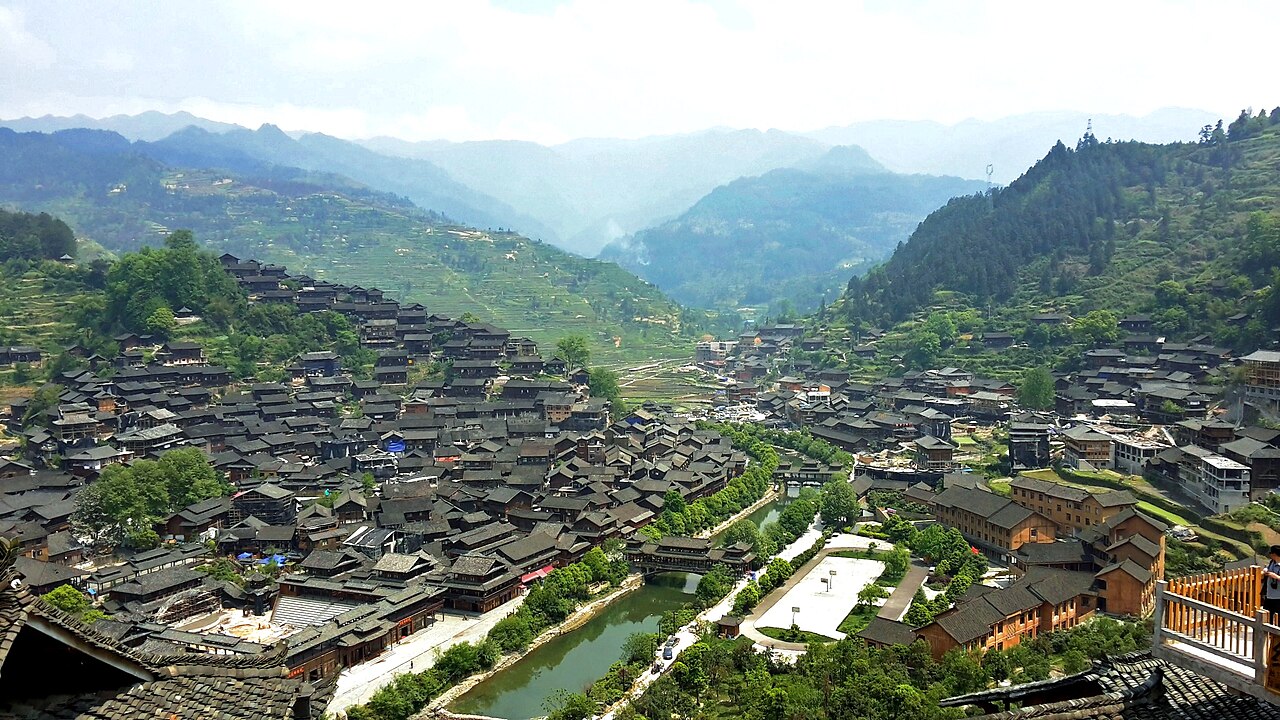
Qianling Park (黔灵公园)
A 426-hectare wooded park in the northwest of the city, with a lake, a nine-bend stone path and Hongfu Temple at the top. Entry is ¥5; the macaques along the path are wild and bold. Buses stop at 'Qianlingshan Park' station.
Guiyang · Guizhou
Guiyang is Guizhou's cool-summer capital and the gateway to Huangguoshu Falls — 2 days cover Qianling Park, Jiaxiu Tower and Qingyan Ancient Town, within 30 km of downtown.
The short version
The place itself
Guiyang does not look like a tourist city at first. It is a working provincial capital of grey apartment blocks stacked on hills, with a skyline that keeps disappearing into low cloud and a reputation built entirely on one thing: it is cool. The slogan on every billboard is 'Shuangshuang de Guiyang' — 'refreshing Guiyang' — and in July, when Chongqing bakes at 40°C, this 1,100 m plateau city sits at 24°C and sleeps under a thin quilt.
What surprises visitors is how much sits within a 30 km radius. Qianling Park, with wild macaques and a working Buddhist temple, is inside the city limits. Jiaxiu Tower, a three-storey Ming pavilion on a rock in the Nanming River, is downtown. Qingyan Ancient Town, a Ming-dynasty garrison with stone alleys and rose-sugar candy, is a 40-minute bus ride south. Huaxi Park, Tianhetan's karst caves and Hongfeng Lake's maple shoreline are all day trips you can do on public buses.
And then there is the food, which is the real reason people come back. Guizhou cooking is sour and hot rather than just hot — the sour comes from fermented tomato and rice broth, not vinegar — and it produces dishes you cannot get properly anywhere else: sour-fish hotpot, silkworm-baby wraps, changwang noodles and Qingyan's braised pig trotters. The night markets are the point.
Pins are plotted from real latitude and longitude on a 5° graticule. This is a schematic orientation diagram, not a political map — no boundaries are drawn.
A 426-hectare wooded park in the northwest of the city, with a lake, a nine-bend stone path and Hongfu Temple at the top. Entry is ¥5; the macaques along the path are wild and bold. Buses stop at 'Qianlingshan Park' station.
Built on a boulder in the Nanming River, first raised in the Ming dynasty and rebuilt in 1909, three storeys and about 20 m tall. Entry is ¥4. It is the city's emblem and looks best lit up after dark.
A 1378 Ming garrison town 29 km south of downtown, one of Guizhou's four great ancient towns, with stone-paved lanes, temples and the best braised pig trotter in the province. Peak entry ¥34, low season ¥30.
A karst scenery park in Huaxi district combining a 210 m waterfall, water caves, dry caves and a natural stone bridge. Entry ¥50 peak, ¥40 low season, open 08:00–17:30; bus 211 from Hebin Park.
The 'Pearl of the Plateau', 17 km from downtown, where the Huaxi River runs over rocks and past pavilions. Entry ¥6; bus 26 runs there every 20 minutes from 08:00 to 17:30.
A man-made lake 28 km west of the city, ringed with sweetgum maples that turn red in late autumn, dotted with Miao and Dong-style buildings on the islands. Entry ¥40 peak, ¥30 low season.
Almost everyone arrives at Guiyang Longdongbao International Airport (KWE), 12 km from downtown and about 15 minutes along the airport expressway. The airport shuttle leaves from outside the terminal and runs to Hebin Park, the stadium and the CAAC ticket office near the junction of Zunyi Road and Qingyun Road for ¥10. Bus 46, 216, 234 and 244 also serve the airport. Taxis officially run about ¥30 to the centre, but drivers have a long-standing habit of quoting a flat ¥50 — agree the price or insist on the meter before you get in, and do not announce your destination before the doors are shut if you want to avoid being refused. By rail, Guiyang is the province's main rail hub, with direct trains to Beijing, Shanghai, Nanjing, Hangzhou, Guangzhou, Wuhan, Kunming and Chengdu, plus tourist trains to Liupanshui (for Huangguoshu) and Yuping (for Fanjing Mountain). The main railway station sits inside the city; buses 1 and 2 from the exit reach the centre.
Inside the city, buses are the workhorse: ¥1 in the urban area, ¥2 on suburban routes including Huaxi and Jinyang, exact change required and front-door boarding only. Minibuses cover more than 30 routes at ¥1.2 (¥1.4 after 22:00) and reach almost everywhere, but they are individually owned and race each other — sit down and hold on. Taxis start at ¥8 for 3 km plus a ¥1 fuel surcharge, then ¥1.60/km by day (06:30–22:00) and ¥1.92/km at night (22:00–06:30); the same trip can cost ¥9 or ¥20 depending on traffic, so allow time. Unlicensed cars are everywhere and sometimes cheaper, but safety is not guaranteed — avoid them, especially at night. Expect congestion around Penshuichi in rush hour; the city's drivers brake hard and cut across lanes without warning.
| Month | Weather | Crowds | Verdict |
|---|---|---|---|
| January | 4°C / -4°C · dry, cold | Quiet | Avoid |
| February | 6°C / -1°C · dry, cold | Very busy | Avoid |
| March | 14°C / 5°C · dry, cold | Moderate | Good |
| April | 21°C / 12°C · clear and mild | Moderate | Best |
| May | 27°C / 18°C · clear and mild | Busy | Best |
| June | 31°C / 23°C · hot, humid | Moderate | OK |
| July | 32°C / 25°C · hot, humid | Busy | OK |
| August | 30°C / 24°C · hot, humid | Busy | OK |
| September | 26°C / 19°C · clear and mild | Moderate | Best |
| October | 20°C / 12°C · clear and mild | Very busy | Best |
| November | 12°C / 4°C · dry, cold | Quiet | Good |
| December | 5°C / -2°C · dry, cold | Quiet | Good |
Two days is the honest minimum, and the source guide agrees. Day one takes in Qianling Park and Hongfu Temple in the morning, Jiaxiu Tower and the Nanming River after lunch, then Hongfeng Lake or the Hequn Road night market in the evening. Day two runs south: Tianhetan's caves first, then Qingyan Ancient Town for lunch and the pig trotters, then Huaxi Park on the way back. A third day buys the wider province — the Huangguoshu Falls and Longgong caves to the southwest, or Zunyi's Red Army sites to the north — and most travellers add it, because both are genuinely worth the drive.
Plan these days properlyMarch to October, with July and August the peak because Guiyang is a genuine cool-summer escape — July averages 23.7°C and the city rarely exceeds 30°C. Winter is mild but damp, with January averaging 4.6°C, and the province's 'no three clear days' weather means you should carry an umbrella year-round.
About 2 to 2.5 hours by road or tourist train southwest of the city. Most travellers join a day tour or take the tourist train to Anshun and a bus onward; the falls themselves need about 1.5 hours, and the Tianxingqiao stone forest and Doupotang waterfall in the same scenic area add another 1.5 hours.
It is hot but also sour, which makes it more approachable than pure chilli heat. Guizhou cooking leans on fermented tomato and rice sour broth, so sour-fish hotpot is tangy rather than punishing. Say 'bu yao la' (no chilli) or 'wei la' (mild) and most kitchens will adjust; the numbing peppercorn in dishes like crispy duck is a separate sensation and can be left off.
Generally yes, but watch your bag in crowded places, especially around the railway station, and avoid walking alone late at night. The bigger practical risk is traffic: taxis stop suddenly in the fast lane and minibuses drive aggressively.
Head indoors to the Guizhou Provincial Museum on Beijing Road — the ground floor of the same building houses the Qianyi Bao craft shop selling Miao embroidery, silverwork and batik. Tianhetan's water caves and the karst caverns at Longgong are also largely sheltered and arguably better in rain, when the waterfalls run full.
Budget around ¥800 per person for two days including a mid-range hotel, meals and transport. Tickets are cheap — Qianling Park ¥5, Jiaxiu Tower ¥4, Huaxi Park ¥6 — and a good meal of sour-fish hotpot runs about ¥70 per person at a popular restaurant like Lao Kaili.
Free itinerary design, a revised plan within one working day, and nothing charged until you approve the final version.