Yungang Grottoes
A UNESCO site of 51,000 Buddhist statues carved into a kilometre of cliff from 460 AD, in the Northern Wei capital. Caves 5 and 6 — the twin pagoda caves — and the giant open-air Buddha of Cave 20 are the unmissable set pieces.
Datong · Shanxi
Datong, in northern Shanxi, holds the 1,500-year-old Yungang Grottoes and the cliff-hung Xuankong Temple. Private tours from US$159 a day, 100 minutes from Beijing by rail.
The short version
The place itself
Datong sits high on the northern edge of Shanxi, close to Inner Mongolia, and it has been a frontier city for most of two thousand years — which is precisely why the art here is so big. It was the capital of the Northern Wei dynasty in the fifth century, and the emperors of that dynasty, newly converted to Buddhism, carved a whole mountain into Buddhas.
Yungang is the result. About 16 km west of the city, a kilometre of cliff is filled with 45 major caves and more than a thousand smaller niches, holding some 51,000 statues. The scale is deliberate: the earliest caves hold colossal seated Buddhas cut to look like the emperors themselves, and the carving gets finer and stranger as you move through, ending in a hall of towering rock-cut pillars and painted caves you can walk inside.
The city itself has been rebuilt quickly from its coal-mining past, and the walled old town now has a dozen sights worth an afternoon: the Huayan and Shanhua temples, survivors of the Liao and Jin dynasties; the Nine-Dragon Screen, the oldest and largest in China; and the souvenirs — tomb figurines, incense burners — of a frontier town learning to sell its history.
An hour or two south lie the two places most people pair with Yungang. The Hanging Temple clings to the Hengshan cliffs above a gorge, a wooden monastery held by beams socketed into the rock; and at Yingxian the 11th-century Sakyamuni Pagoda is the oldest and tallest timber tower in China, still standing after nearly a thousand years of earthquakes.
Pins are plotted from real latitude and longitude on a 5° graticule. This is a schematic orientation diagram, not a political map — no boundaries are drawn.
A UNESCO site of 51,000 Buddhist statues carved into a kilometre of cliff from 460 AD, in the Northern Wei capital. Caves 5 and 6 — the twin pagoda caves — and the giant open-air Buddha of Cave 20 are the unmissable set pieces.
A 1,500-year-old monastery of 40 halls and pavilions pinned to the Hengshan cliff, 75 m above the gorge and held up by beams lodged in the rock. The only temple in China that ever worshipped Buddha, Dao and Confucius together.
The best-preserved Liao and Jin temple complex in China, unusual for facing east rather than south — a mark of the Khitan who built it. Beneath its wooden pagoda is a 500 m² hall of 1,000 Buddhas cast in 100 tonnes of bronze.
The most complete Liao and Jin temple layout surviving anywhere, ranged along a Tang-style axis with fine Guardian King murals and a vast bramble-thorn Jin-dynasty dado.
Built in 1392 for a Ming prince, this is the oldest and largest glazed-tile dragon screen in China — 45.5 m long, made of 426 sculpted tiles, and 250 years older than the one in Beijing.
The oldest and tallest all-timber pagoda on earth, built in 1056 with no nails and still standing after a millennium of earthquakes. Half a day south of Datong, best combined with the Hanging Temple.
Datong Yungang Airport (DAT), 15 km from the centre, has domestic flights only — Beijing, Shanghai, Taiyuan and a handful of others — so most travellers come by rail or connect through Beijing. The high-speed line from Beijing takes about 100 minutes, which makes Datong a realistic day trip or overnight from the capital.
Once in Datong, taxis and buses handle the city; the sights are spread out, though, so a car with a driver is the practical way to reach Yungang, the Hanging Temple and the Yingxian pagoda. City buses 3-1, 3-2 and 10 run to the Yungang site, and 601 is the fast route from the station. For the out-of-town cluster, agree the price and the route before you set off.
| Month | Weather | Crowds | Verdict |
|---|---|---|---|
| January | 4°C / -4°C · dry, cold | Quiet | Avoid |
| February | 6°C / -1°C · dry, cold | Very busy | Avoid |
| March | 14°C / 5°C · dry, cold | Moderate | Good |
| April | 21°C / 12°C · clear and mild | Moderate | Best |
| May | 27°C / 18°C · clear and mild | Busy | Best |
| June | 31°C / 23°C · hot, humid | Moderate | OK |
| July | 32°C / 25°C · hot, humid | Busy | OK |
| August | 30°C / 24°C · hot, humid | Busy | OK |
| September | 26°C / 19°C · clear and mild | Moderate | Best |
| October | 20°C / 12°C · clear and mild | Very busy | Best |
| November | 12°C / 4°C · dry, cold | Quiet | Good |
| December | 5°C / -2°C · dry, cold | Quiet | Good |
Two days is the standard. Day one is Yungang in the morning and the city temples — Huayan, Shanhua, the Nine-Dragon Screen — in the afternoon. Day two heads south for the Hanging Temple and the Yingxian wooden pagoda. A third day lets you add the Hengshan mountain itself, or go underground at the Jinhuagong coal-mine park next to Yungang.
Plan these days properly Transport
China's High-Speed Rail: How to Book, What It Costs, How Fast It Goes
The fastest way to cross China is also the most pleasant. Here is how to book a ticket with a foreign passport, what the three classes actually give you, and how to survive a Chinese station at rush hour.
9 min read
Transport
China's High-Speed Rail: How to Book, What It Costs, How Fast It Goes
The fastest way to cross China is also the most pleasant. Here is how to book a ticket with a foreign passport, what the three classes actually give you, and how to survive a Chinese station at rush hour.
9 min read
 Planning
Best Time to Visit China: Month by Month, Region by Region
China is the size of Europe, so 'the best month' depends on where you stand. Here is the month-by-month answer for the north, the Yangtze valley, the south and the plateau.
8 min read
Planning
Best Time to Visit China: Month by Month, Region by Region
China is the size of Europe, so 'the best month' depends on where you stand. Here is the month-by-month answer for the north, the Yangtze valley, the south and the plateau.
8 min read
 Taiyuan
Shanxi · 4 tours
Taiyuan is the capital of Shanxi and a city of 5.3 million, and most travellers use it as the hub for Pingyao, Mount Wutai and Datong — but it earns a
Taiyuan
Shanxi · 4 tours
Taiyuan is the capital of Shanxi and a city of 5.3 million, and most travellers use it as the hub for Pingyao, Mount Wutai and Datong — but it earns a
 Pingyao
Shanxi · 4 tours
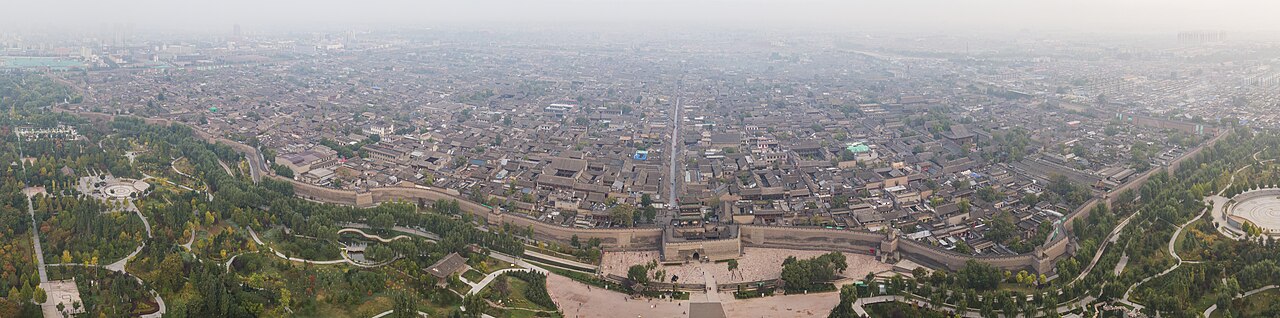
Pingyao is China's best-preserved ancient county town, a UNESCO World Heritage site with a 6 km Ming-dynasty wall, 2,800 years of history and the firs
Pingyao
Shanxi · 4 tours
Pingyao is China's best-preserved ancient county town, a UNESCO World Heritage site with a 6 km Ming-dynasty wall, 2,800 years of history and the firs
High-speed rail, about 100 minutes from Beijing to Datong South. There are also a few slower overnight trains. Flying is possible but the airport is domestic-only and slower than the train, so rail is the answer.
Allow three to four hours. The site is a full kilometre long, so ride the shuttle bus to the far end and walk back through the caves. Caves 5, 6 and the open-air Buddha of Cave 20 are the highlights; a rented audio guide is worth the small fee.
Yes, if you have a second day. It is a genuine wonder — 40 halls balanced on beams driven into a cliff 75 m above the gorge — and it pairs naturally with the Yingxian wooden pagoda on the same half-day loop. Go early; the walkways are narrow and it gets crowded.
What you eat anywhere in Shanxi, only better: knife-cut noodles (daoxiaomian), sliced and shaved into the pot by hand; steamed oaten noodles; and for the brave, spiced braised rabbit head. Prices are low and portions are large.
May to October, with September and October the pick. Summers are dry and hot in the sun, spring brings wind and dust, and winters are genuinely cold at this altitude. Whatever the season, bring a layer for the evenings.
Free itinerary design, a revised plan within one working day, and nothing charged until you approve the final version.